Saturday, 27 April 2013

The Lost Ark of the Covenant

The Lost Ark of the Covenant

By David Shyovitz


As a general rule, Judaism rejects physical manifestations of spirituality, preferring instead to focus on actions and beliefs. Indeed, the story of Judaism begins with Abraham who, according to ancient sources, shattered the idols that were the conventional method of religious observance at the time. Worship of graven images is harshly condemned throughout the Torah, and perhaps the greatest sin the Israelites collectively committed was the construction of the Golden Calf (in Ex. 32), intended to serve as a physical intermediary between them and God. Today, Jews do not venerate any holy relics or man-made symbols.
But in the history of the Jewish people, there was one exception to this rule. One man-made object was considered intrinsically holy - the Ark of the Covenant. Constructed during the Israelites' wanderings in the desert and used until the destruction of the First Temple, the Ark was the most important symbol of the Jewish faith, and served as the only physical manifestation of God on earth. The legends associated with this object - and the harsh penalties ascribed for anyone who misuses it - confirm the Ark's centrality to the Jewish faith of that period; the fact that Jews and non-Jews alike continue to study and imitate it confirms its centrality even today.

Building the Ark

The construction of the Ark is commanded by God to Moses while the Jews were still camped at Sinai (Ex. 25:10-22; 37:1-9). The Ark was a box with the dimensions of two-and-a-half cubits in length, by one-and-a-half cubits in heights, by one-and-a-half cubits in width (a cubit is about 18 inches). It was constructed of acacia wood, and was plated with pure gold, inside and out. On the bottom of the box, four gold rings were attached, through which two poles, also made of acacia and coated in gold, were put. The family of Kehath, of the tribe of Levi, would carry the ark on their shoulders using these poles.
Covering the box was the kapporet, a pure gold covering that was two-and-a-half by one-and-a-half cubits. Attached to the kapporet were two sculpted Cherubs, also made of pure gold. The two Cherubs faced one another, and their wings, which wrapped around their bodies, touched between them.
The contents of the Ark has been debated through the centuries. The general consensus is that the first tablets containing the Ten Commandments, which were broken by Moses, and the second tablets, which remained intact, were contained in the Ark (Bava Batra 14b). According to one opinion in the Talmud, both Tablets were together in the Ark; according to another, there were two Arks, and each contained one set of Tablets (Berakhot 8b).
The Ark was built by Bezalel, son of Uri, son of Hur, who constructed the entire Tabernacle – the portable Temple used in the desert and during the conquest of the land of Israel. The Tabernacle was the resting place for the Ark, and also contained other vessels that were used in the physical worship of God. The Biblical commentators argue over why God commanded Moses to build a Tabernacle in the first place: According to Rashi (Ex. 31:18), God realized after the sin of the Golden Calf that the Israelites needed an outlet for physical worship, and commanded that they build the Tabernacle as a way of expressing their own need for physical representation of God. According to Nachmanides (Ex. 25:1), however, the Jews were commanded to build the Tabernacle even before the sin of the Golden Calf; rather than filling a human need, the Tabernacle was God's method of achieving continuous revelation in the Israelites' camp. These two opinions as to whether the Tabernacles, and the Temples that followed them, were an a priori necessity or a necessary evil demonstrate the controversial role of physical worship in Judaism as a whole.

The Role of the Ark

The Ark was used in the desert and in Israel proper for a number of spiritual and pragmatic purposes. Practically, God used the Ark as an indicator of when he wanted the nation to travel, and when to stop. In the traveling formation in the desert, the Ark was carried 2000 cubits ahead of the nation (Num. R. 2:9). According to one midrash, it would clear the path for the nation by burning snakes, scorpions, and thorns with two jets of flame that shot from its underside (T. VaYakhel, 7); another midrash says that rather than being carried by its bearers, the Ark in fact carried its bearers inches above the ground (Sotah 35a). When the Israelites went to war in the desert and during the conquering of Canaan, the Ark accompanied them; whether its presence was symbolic, to provide motivation for the Jews, or whether it actually aided them in fighting, is debated by commentators.
Spiritually, the Ark was the manifestation of God's physical presence on earth (the shekhina). When God spoke with Moses in the Tent of Meeting in the desert, he did so from between the two Cherubs (Num. 7:89). Once the Ark was moved into the Holy of Holies in the Tabernacle, and later in the Temple, it was accessible only once a year, and then, only by one person. On Yom Kippur, the High Priest (Kohen Gadol) could enter the Holy of Holies to ask forgiveness for himself and for all the nation of Israel (Lev. 16:2).
The relationship between the Ark and the shekhina is reinforced by the recurring motif of clouds. God's presence is frequently seen in the guise of a cloud in the Bible (Ex. 24:16), and the Ark is constantly accompanied by clouds: When God spoke from between the Cherubs, there was a glowing cloud visible there (Ex. 40:35); when the Jews traveled, they were led by the Ark and a pillar of clouds (Num. 10:34); at night, the pillar of clouds was replaced by a pillar of fire, another common descriptor of God's appearance (Ex. 24:17); and when the High Priest entered presence of the Ark on Yom Kippur, he did so only under the cover of a cloud of incense, perhaps intended to mask the sight of the shekhina in all its glory (Lev. 16:13).
The holiness of the Ark also made it dangerous to those who came in contact with it. When Nadav and Avihu, the sons of Aaron, brought a foreign flame to offer a sacrifice in the Tabernacle, they were devoured by a fire that emanated "from the Lord" (Lev. 10:2). During the saga of the capture of the Ark by the Philistines, numerous people, including some who merely looked at the Ark, were killed by its power. Similarly, the Priests who served in the Tabernacle and Temple were told that viewing the Ark at an improper time would result in immediate death (Num. 4:20).

History of the Ark

The Ark accompanied the Jews throughout their time in the desert, traveling with them and accompanying them to their wars with Emor and Midian. When the Jews crossed into the land of Canaan, the waters of the Jordan River miraculously split and the Ark led them through (Josh. 3). Throughout their conquest of the land, the Jews were accompanied by the Ark. The most dramatic demonstration of its power comes when the Jews breached the walls of Jericho merely by circling them, blowing horns and carrying the Ark (Josh. 6).
After the conquest was completed, the Ark, and the entire Tabernacle, were set up in Shiloh (Josh. 18) . There they remained until the battles of the Jews with the Philistines during the Priesthood of Eli. The Jews, after suffering a defeat at the Philistines' hands, took the Ark from Shiloh to Even-Ezer in hopes of winning the next battle. But the Jews were routed, and the Ark was captured by the Philistines. Back in Shiloh, Eli, the High Priest, immediately died upon hearing the news (I Sam. 4).
The Philistines took the Ark back to Ashdod, their capital city in the south of Canaan, where they placed it in the temple of their god Dagon. The next day, however, they found the idol fallen on its face. After replacing the statue, they found it the next day decapitated, with only its trunk remaining, and soon afterward, the entire city of Ashdod was struck with a plague. The Philistines moved the Ark to the city of Gath, and from there to Ekron, but whatever city the Ark was in, the inhabitants were struck with plague. After seven months, the Philistines decided to send the Ark back to the Israelites, and accompanied it with expensive gifts. The Ark was taken back to Beit Shemesh, and, according to midrash, the oxen pulling the Ark burst into song as soon as it was once again in Israel's possession (A.Z. 22b). The actual text of the story, however, tells a much grimmer tale: The men of Beit Shemesh were punished for staring disrespectfully at the Ark, and many were killed with a plague.
From Beit Shemesh, the Ark was transported to Kiryat Yearim, where it remained for twenty years. From there, King David transported it to Jerusalem. En route, however, the oxen pulling it stumbled, and when Uzzah reached out to steady the Ark, he died immediately. As a result of this tragedy, David decided to leave the Ark at the home of Obed-edom the Gittite. Three months later, he moved it to Jerusalem, the seat of his kingdom, where it remained until the construction of the First Temple by David's son Solomon (I Sam. 5-6). When the Ark was finally placed in the Temple, the midrash reports that the golden tree decorations that adorned the walls blossomed with fruit that grew continuously until the Temple's destruction (Yoma 39b).

The Ark's Whereabouts


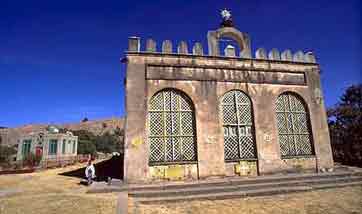
The Church of St. Mary. The Treasury that is said to contain the Ark is in the background on the left.
The Ark remained in the Temple until its destruction at the hand of the Babylonian empire, led by Nebuchadnezzar. What happened to it afterward is unknown, and has been debated and pondered for centuries. It is unlikely that the Babylonians took it, as they did the other vessels of the Temple, because the detailed lists of what they took make no mention of the Ark. According to some sources, Josiah, one of the final kings to reign in the First Temple period, learned of the impending invasion of the Babylonians and hid the Ark. Where he hid it is also questionable – according to one midrash, he dug a hole under the wood storehouse on the Temple Mount and buried it there (Yoma 53b). Another account says that Solomon foresaw the eventual destruction of the Temple, and set aside a cave near the Dead Sea, in which Josiah eventually hid the Ark (Maimonides, Laws of the Temple, 4:1).
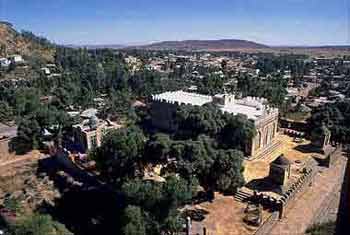
Aerial view of the courtyard of the St. Mary Church in Axum, Ethiopia.
One of the most fascinating possibilities is advanced by Ethiopian Christians who claim that they have the Ark today. In Axum, Ethiopia, it is widely believed that the Ark is currently being held in the Church of Saint Mary of Zion, guarded by a monk known as the "Keeper of the Ark," who claims to have it in his possesion. According to the Axum Christian community, they acquired the Ark during the reign of Solomon, when his son Menelik, whose mother was the Queen of Sheba, stole the Ark after a visit to Jerusalem. While in the not-so-distant past the "Ark" has been brought out for Christian holidays, its keeper has not done so for several years due to the tumultuous political situation in the country. The claim has thus been impossible to verify, for no one but the monk is allowed into the tent.
A more plausible claim is that of archaeologist Leen Ritmeyer, who has conducted research on the Temple Mount and inside the Dome of the Rock. He claims to have found the spot on the Mount where the Holy of Holies was located during the First Temple period. In the precise center of that spot is a section of bedrock cut out in dimensions that may match those of the Ark as reported in Exodus. This section of the mount, incidentally, is the one from which the creation of the world began, according to midrash (T. Kedoshim, 10). Based on his findings, Ritmeyer has postulated that the Ark may be buried deep inside the Temple Mount. However, it is unlikely that any excavation will ever be allowed on the Mount by the Muslim or Israeli authorities.
The Role of the Ark Today

The Ark remains a topic of study even today, over 2000 years after it was last seen. A great deal of research has attempted to explain the wonders that are attributed to the Ark in the Bible. One recent study suggests the possibility that the Ark represented man's first harnessing of electricity. The accounts given of peoples' sudden deaths from touching the Ark are consistent with death by a high voltage, lethal electrical charge. Such a charge could have resulted from the constant exposure of the box to static electricity, which builds up quickly in a hot, dry climate like the Middle East. The materials that the Ark was made of further support this theory: gold is one of the most powerful electrical conductors, and wood is an excellent insulator.
The only remnant of the Ark in Jewish life today is the Holy Ark in which Torah scrolls are kept in synagogues. These Arks often are decorated with copies of the Tablets, reminiscent of the contents of the actual Ark of ancient times. The Ark itself plays no role in Jewish life today. Nonetheless, it remains a potent symbol of the Jewish peoples' past, and of the messianic era many believe is waiting in the future.
Ironically, the Ark is most famous today as the subject of the 1981 film "Indiana Jones and the Raiders of the Lost Ark." The movie tells of a hero's attempt to prevent the Ark from falling into the hands of the Nazis, who would harness its power for evil. While there is no evidence of Hitler ever having had an interest in the Ark, the movie does an admirable job of capturing the mystique of one of the worlds' most ancient unsolved mysteries.

Saturday, 16 March 2013


A wise man once taught me, always have a contingency plan.

Abraham Lincoln


History prefers legends to men; it prefers Nobility to Brutality,
Soaring speeches to quite deeds.  
History remembers the battle and forgets the blood.
However history remember need for does it all; it shall long remember a fraction of truth.

By 
Abraham Lincoln

ANCIENT UNDERWATER CITIES

ANCIENT UNDERWATER CITIES

Ancient Japanese Underwater Pyramids
Ancient Japanese Underwater PyramidsAncient Japanese Underwater Pyramids

The island of Yonaguni, near Okinawa, Japan has long been a favorite diving spot for swimmers try to get a glance of the numerous hammerhead sharks that swim there. However, in 1995 underwater explorer Kihachirou Aratake found a very large, strange structure under the water. Lying about 60 feet deep, the structure appeared to be man-made. Large steps could be seen, blocks of rock cut at right angles and smoothed. The discovery would send shock waves through the archaeological world.
 
Japan's Underwater Pyramids or Ruins as they have become to be known are a mystery. In all, around eight sites have been discovered. There are certain features that are very hard to dismiss as natural occurrences. Such as a large, semi-circular structure that almost looks like a park bench. Then there is a large head which appears to have hair and a head dress carved into it. There are also numerous round holes carved into the rock, including some that look as though they were made to support large wooden poles. Again, these are just hard to dismiss, including this head with eyes carved out of it. As stated, the structures are lying on the seabed, around 60 to 100 feet below the surface. The last time that these areas were not covered by the ocean was between approximately 8 to 12 thousand years ago, during the last ice age when much of the sea was caught up in the ice caps. At the time Yonaguni formed a landbridge with Taiwan, leading many to speculate that the area is part of the lost continent of Mu, or Lemuria.

Cleopatra's Palace in Alexandria (Egypt)
Cleopatra's Palace in Alexandria Egypt

Off the shores of Alexandria, the city of Alexander the Great, lies what is believed to be the ruins of the royal quarters of Cleopatra. A team of marine archaeologists led by Frenchman Franck Goddio made excavation on this ancient city from where Cleopatra, the last queen of the Ptolemies, ruled Egypt. Historians believe this site was submerged by earthquakes and tidal waves more than 1,600 years ago.

The excavations concentrated on the submerged island of Antirhodus. Cleopatra is said to have had a palace there. Other discoveries include a well-preserved shipwreck and red granite columns with Greek inscriptions. There were also founded two statues which were lifted out of the harbor. One was a priest of the goddess Isis; the other a sphinx whose face is said to represent Cleopatra's father, King Ptolemy XII. The artifacts were returned to their silent, because the Egyptian Government says it wants to leave most of them in place to create an underwater museum

2 HUGE UNDERWATER CITIES FOUND IN INDIA
Two large cities found underwater near India
Lost city 'could rewrite history'
The remains of what has been described as a huge lost city may force historians and archaeologists to radically reconsider their view of ancient human history.

Marine scientists say archaeological remains discovered 36 meters (120 feet) underwater in the Gulf of Cambay off the western coast of India could be over 9,000 years old.

The vast city - which is five miles long and two miles wide - is believed to predate the oldest known remains in the subcontinent by more than 5,000 years. 

The site was discovered by chance last year by oceanographers from India's National Institute of Ocean Technology conducting a survey of pollution.

Using sidescan sonar - which sends a beam of sound waves down to the bottom of the ocean they identified huge geometrical structures at a depth of 120ft.

Debris recovered from the site - including construction material, pottery, sections of walls, beads, sculpture and human bones and teeth has been carbon dated and found to be nearly 9,500 years old. 

Lost civilization 
The city is believed to be even older than the ancient Harappan civilization, which dates back around 4,000 years.

Marine archaeologists have used a technique known as sub-bottom profiling to show that the buildings remains stand on enormous foundations.

Author and film-maker Graham Hancock - who has written extensively on the uncovering of ancient civilizations - told BBC News Online that the evidence was compelling:

"The [oceanographers] found that they were dealing with two large blocks of apparently man made structures.

"Cities on this scale are not known in the archaeological record until roughly 4,500 years ago when the first big cities begin to appear in Mesopotamia.

"Nothing else on the scale of the underwater cities of Cambay is known. The first cities of the historical period are as far away from these cities as we are today from the pyramids of Egypt," he said. 


Chronological problem 

This, Mr Hancock told BBC News Online, could have massive repercussions for our view of the ancient world.

"There's a huge chronological problem in this discovery. It means that the whole model of the origins of civilization with which archaeologists have been working will have to be remade from scratch," he said.

However, archaeologist Justin Morris from the British Museum said more work would need to be undertaken before the site could be categorically said to belong to a 9,000 year old civilization.

"Culturally speaking, in that part of the world there were no civilizations prior to about 2,500 BC. What's happening before then mainly consisted of small, village settlements," he told BBC News Online.

Dr Morris added that artifacts from the site would need to be very carefully analyzed, and pointed out that the C14 carbon dating process is not without its error margins.

It is believed that the area was submerged as ice caps melted at the end of the last ice age 9-10,000 years ago.
The remains of what has been described as a huge lost city may force historians and archaeologists to radically reconsider their view of ancient human history. Marine scientists say archaeological remains discovered 36 metres (120 feet) underwater in the Gulf of Cambay off the western coast of India could be over 9,000 years old. The vast city - which is five miles long and two miles wide - is believed to predate the oldest known remains in the subcontinent by more than 5,000 years. The site was discovered by chance last year by oceanographers from India's National Institute of Ocean Technology conducting a survey of pollution. Using sidescan sonar - which sends a beam of sound waves down to the bottom of the ocean they identified huge geometrical structures at a depth of 120ft. Debris recovered from the site - including construction material, pottery, sections of walls, beads, sculpture and human bones and teeth has been carbon dated and found to be nearly 9,500 years old. 

Lost civilisation
The city is believed to be even older than the ancient Harappan civilisation, which dates back around 4,000 years.
Marine archaeologists have used a technique known as sub-bottom profiling to show that the buildings remains stand on enormous foundations.
The whole model of the origins of civilisation will have to be remade from scratch

Graham Hancock
Author and film-maker Graham Hancock - who has written extensively on the uncovering of ancient civilisations - told BBC News Online that the evidence was compelling:
"The [oceanographers] found that they were dealing with two large blocks of apparently man made structures.
"Cities on this scale are not known in the archaeological record until roughly 4,500 years ago when the first big cities begin to appear in Mesopotamia.
"Nothing else on the scale of the underwater cities of Cambay is known. The first cities of the historical period are as far away from these cities as we are today from the pyramids of Egypt," he said.

Chronological problem
This, Mr Hancock told BBC News Online, could have massive repercussions for our view of the ancient world.
Harappan site in Pakistan, BBC
Harappan remains have been found in India and Pakistan
"There's a huge chronological problem in this discovery. It means that the whole model of the origins of civilisation with which archaeologists have been working will have to be remade from scratch," he said.
However, archaeologist Justin Morris from the British Museum said more work would need to be undertaken before the site could be categorically said to belong to a 9,000 year old civilisation.
"Culturally speaking, in that part of the world there were no civilisations prior to about 2,500 BC. What's happening before then mainly consisted of small, village settlements," he told BBC News Online.
Dr Morris added that artefacts from the site would need to be very carefully analysed, and pointed out that the C14 carbon dating process is not without its error margins.
It is believed that the area was submerged as ice caps melted at the end of the last ice age 9-10,000 years ago
Although the first signs of a significant find came eight months ago, exploring the area has been extremely difficult because the remains lie in highly treacherous waters, with strong currents and rip tides.
The Indian Minister for Human Resources and ocean development said a group had been formed to oversee further studies in the area.
"We have to find out what happened then ... where and how this civilisation vanished," he said.

Friday, 15 March 2013

Dreamiest Destinations


Dreamiest Destinations


Every Friday I post a new amazing destination for you to drool over on Facebook. For those of you who don'tfollow NETC on Facebook (shame on you) or for those who just may have missed them - enjoy the Dream Destinations of July.

Mt. Kelimutu, Indonesia
Mt. Kelimutu in Indonesia
photo via
Mt. Kelimutu is a volcano on the island of Flores featuring three color-changing lakes. The lakes are all different colors and range from from blues, browns, reds and even black. The cause of the color change is thanks to subaqueous fumaroles (cracks in the earth's crust) and the chemical reactions that happen as a result.
Travel to the Asia


Jiuzhaigou Valley, China
photo via

Lovely lakes, majestic waterfalls and snow-capped peaks make up this part of the Min Shan mountain range. The site is a UNESCO World Heritage Site and is among China's most famous scenic spots. 
Travel to China


Waiotapu Thermal Reserve at Rotorua, New Zealand
Waiotapu Thermal Reserve
photo via

A self-proclaimed Thermal Wonderland features the famous champagne pool, sculpted out of thousands of years of volcanic activity. Between the pool, steaming ground and New Zealand's larger bubbling mud pool, this locale is a must see! 
Travel to New Zealand


Val di Funes, Italy
Val di Funes, Italy
photo via

This quaint, lush valley at the foot of the Dolomites is a trekking paradise. Wander through the charming towns and enjoy the picturesque architecture while taking in the gorgeous snow capped mountains. 
Travel to Italy


Green Lake in Styria, Austria
photo via

This bizarre natural phenomena is a must see! Visit in the winter and hike through a beautiful country park OR visit in the summer and dive into the same park - courtesy of melted mountain tops. 


The Lakes of Mount Kelimutu, Indonesia


Kelimutu

Kelimutu ([kəliˈmutu]) is a volcano, close to the small town of Moni about 50 km to the east of Ende, Indonesia in central Flores Island of Indonesia.

Geological details

The volcano contains three striking summit crater lakes of varying colors. Tiwu Ata Mbupu (Lake of Old People) is usually blue and is the westernmost of the three lakes. The other two lakes, Tiwu Nuwa Muri Koo Fai (Lake of Young Men and Maidens) and Tiwu Ata Polo (Bewitched or Enchanted Lake) are separated by a shared crater wall and are typically green or red respectively. The lake colors vary on a periodic basis. Subaqueous fumaroles are the probable cause of active upwelling that occurs at the two eastern lakes.[1]
The lakes have been a source of minor phreatic eruptions in historical time. The summit of the compound 1639-m-high Kelimutu volcano is elongated two km in a WNW-ESE direction; the older cones of Kelido and Kelibara are located respectively three km to the north and two km to the south. The scenic lakes are a popular tourist destination.[2]
Kelimutu is also of interest to geologists because the three lakes are different colors yet are at the crest of the same volcano.[3] According to the local officer at Kelimutu National Park, the colour changes as a result of chemical reactions resulting from the minerals contained in the lake perhaps triggered by volcano gas activity.[4] Kawah Putih lake in West Java, south of Bandung, is another crater lake in Indonesia with some similarities to the lakes at Kelimutu.

Tourism

In the early days of developing the local national park in the Kelimutu area, there were some disputes with local communities over the use of the resources. More recently, forest rangers have worked to develop better relations with nearby village communities and overall management has improved.[5]
Kelimutu is one of the mountains listed as a ribu in Indonesia which are mountains in Indonesia which are more than 1,000 meters high.
The area is said to have begun to attract attention after being noticed by the a regional Dutch military commander, B. van Suchtelen in 1915 and became more well-known after Y. Bouman wrote about the site in 1929.[6]
The closest airports are Maumere, and Ende. There are regular flights to Maumere from Bali. The drive from Maumere to Moni, the town at the base of Kelimutu where accommodation is available, takes about 3 hours.

Gallery


Monday, 15 October 2012

Talian song - Lasciatemi

Lasciatemi cantare
con la chitarra in mano.
Lasciatemi cantare
una canzone piano piano. Buongiorno Italia, gli spaghetti al dente
e un partigiano come presidente,
con l'autoradio sempre nella mano destra
e un canarino sopra la finestra.
Buongiorno Italia, con i tuoi artisti,
con troppa America sui manifesti,
con le canzoni, con amore, con il cuore,
con più donne, sempre meno suore.
Buongiorno Italia, buongiorno Maria,
con gli occhi pieni di malinconia.
Buongiorno Dio
sai che ci sono anch'io.
Lasciatemi cantare
con la chitarra in mano.
Lasciatemi cantare
una canzone piano piano.
Lasciatemi cantare
perchè ne sono fiero.
Sono un italiano,
un italiano vero.
Buongiorno Italia, che non si spaventa,
con la crema da barba alla menta,
con un vestito gessato sul blu
e la moviola la domenica in TV.
Buongiorno Italia, col caffè ristretto,
le calze nuove nel primo cassetto,
con la bandiera in tintoria
e una Seicento giù di carrozzeria.
Buongiorno Italia, Buongiorno Maria,
con gli occhi pieni di malinconia.
Buongiorno Dio
sai che ci sono anch'io.
Lasciatemi cantare
con la chitarra in mano.
Lasciatemi cantare
una canzone piano piano.
Lasciatemi cantare
perchè ne sono fiero.
Sono un italiano, un italiano vero.
Lasciatemi cantare
perchè ne sono fiero.
Sono un italiano,
un italiano vero.
*********************************************************************************
TRANSLATION: Let me sing
with a guitar in my hand
Let me sing
I am an Italian.
Good morning Italy, with rightly cooked spaghetti
and a partisan for president
with a car radio always in the right hand
and a canary at the window
Good morning Italy with your artists,
too much America on the posters
with songs, with love, with heart
with more women, fewer and fewer nuns
Good morning Italy, good morning Mary,
with eyes full of melancholy.
Good morning, God
You know I am here too
Let me sing
with a guitar in my hand
Let me sing
a song softly
Let me sing
because I am proud of this
I am an Italian,
a true Italian
Good morning Italy, that is not afraid
With mint shaving foam
With a blue gessato suit
And matches in replay on Sunday on TV
Good morning Italy, with espresso coffee
new socks in the first drawer
with a flag at the laundry
and a Seicento with an old bodywork